
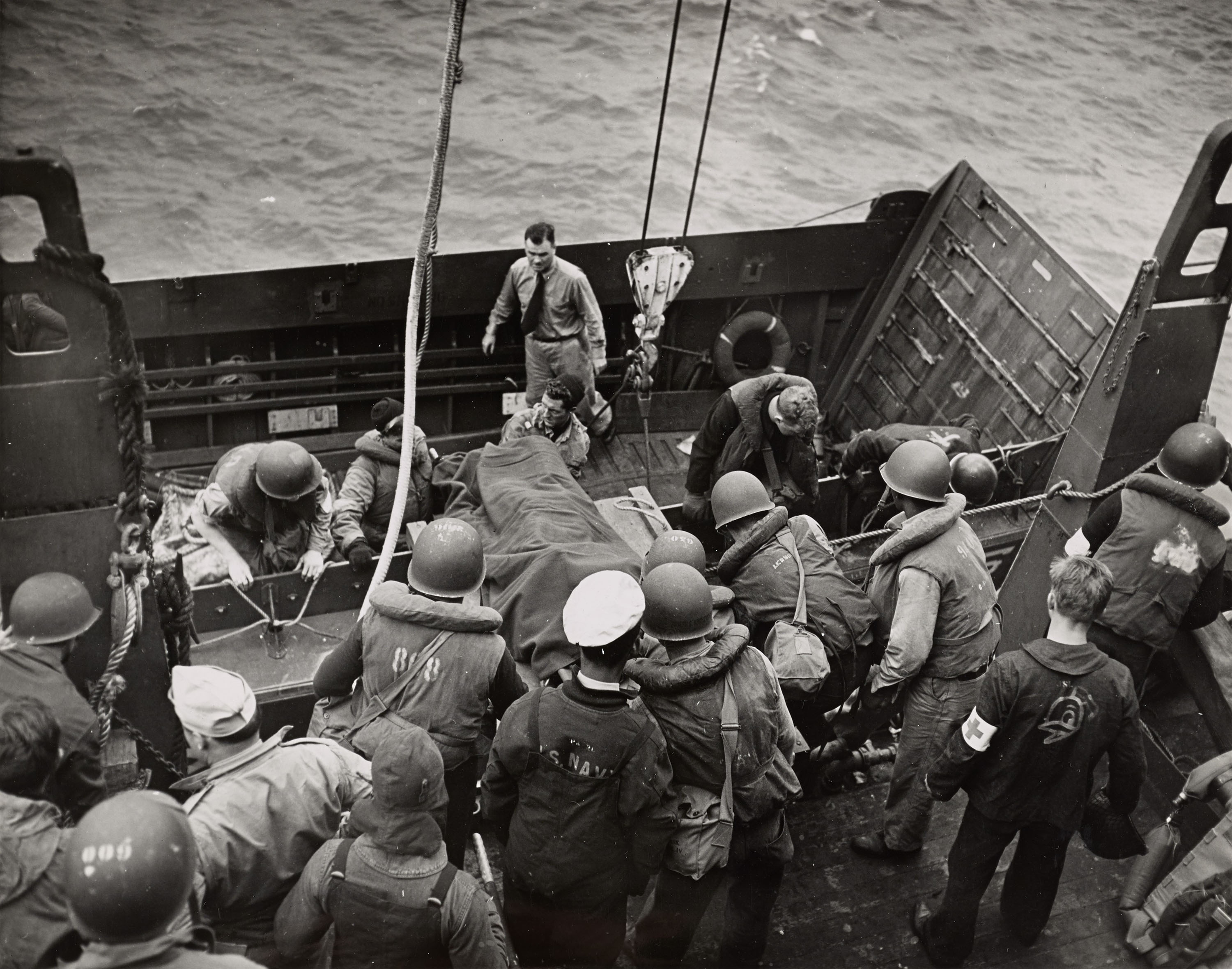
A World War II Coast Guard assault transport that landed American soldiers on the coast of France during the June 6, 1944, D-Day invasion is pressed into service removing wounded Americans from the beaches for transportation to another port for medical attention. National Archives photo
ISSUE:Volume 83, Number 2
AUTHOR: Richard Button
Secretary
National Search and Rescue Committee
Office of Search and Rescue
PART I
Are the rules and obligations different for conducting lifesaving operations at sea during an armed conflict? To be sure, certain rescue concepts exist regardless of the circumstances on scene while others are active only in or near hostilities. This distinction isn’t an academic examination of terminology, but rather it implies lifesaving operation decisions across the globe.
In the aftermath of a naval engagement, the reality is that both sides are likely to have survivors in need of assistance. Who’s required to conduct the recovery operation? Is a belligerent required to recover enemy combatants they just attacked? Can any military ship assist in the recovery effort? How does a military ship conducting the recovery operation keep from becoming a military target?1
The answers to these questions provide a rulebook for conducting rescues in or near an armed conflict, though the framework may seem confusing and counterintuitive. However, this is what International Humanitarian Law (IHL), sometimes called the Law of Armed Conflict (LOAC), requires.2
This paper will address SAR-related questions following a naval engagement and demonstrate how the established global search and rescue (SAR) system can save lives, even in this potentially high-risk environment. Specifically, it will address how the International Convention on Maritime Search and Rescue (SAR Convention) and LOAC complement each other, and how a hospital ship, as defined by LOAC, can be recognized as a place of safety. It will also explain how a coastal rescue craft would be considered a SAR unit under the SAR Convention.
The problem for a belligerent is how to tell the difference between a legitimate military target and civilian vessels when both types of vessels may have a similar lifesaving function.
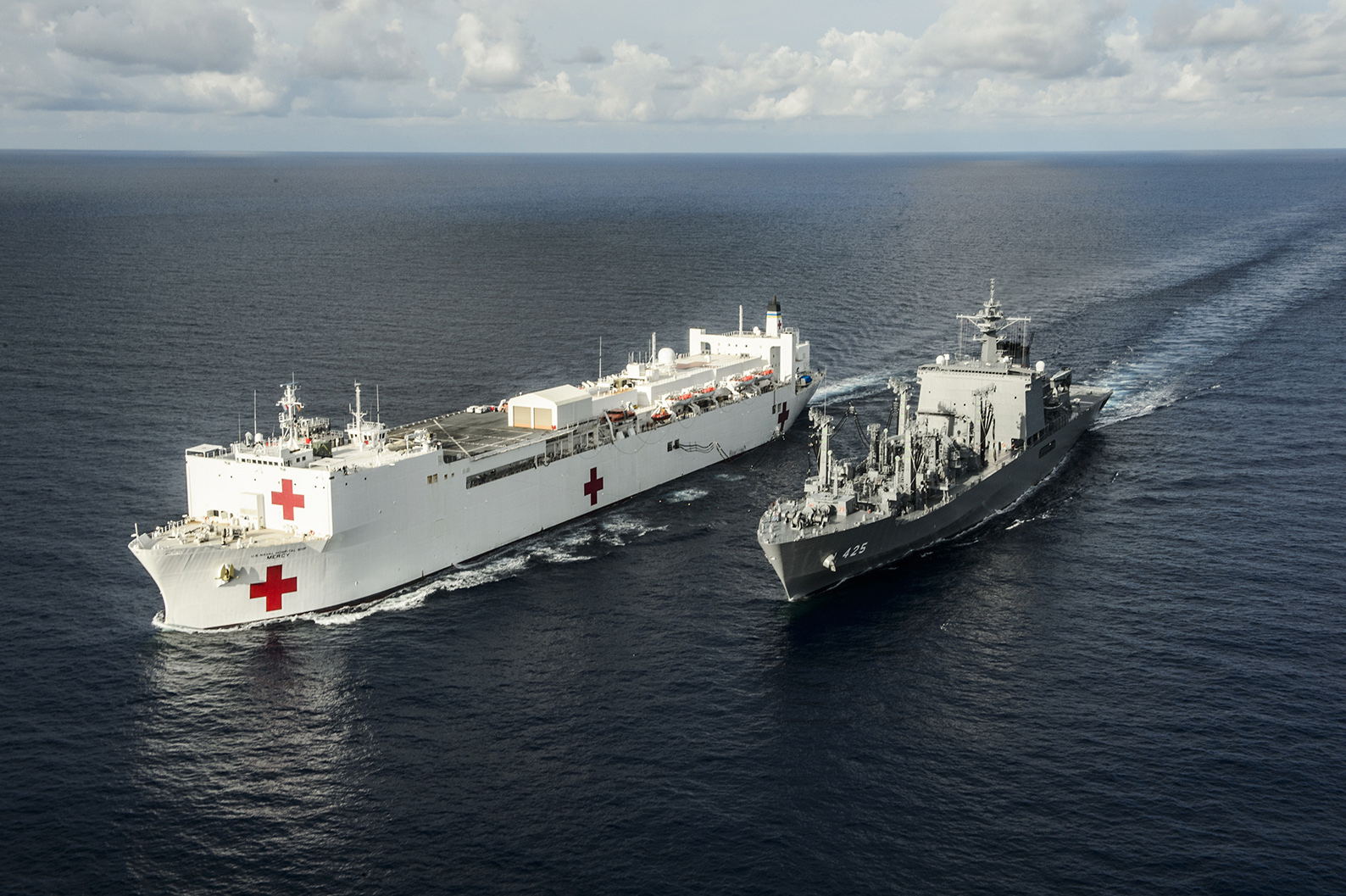
USNS Mercy and Japanese Fleet Oiler JS Mashu conduct a replenishment at sea during Pacific Partnership 2015. Pacific Partnership is an annual, multinational humanitarian and disaster response mission conducted in the Indo-Pacific. Navy photo by Petty Officer 2nd Class Mark El-Rayes
International Law
As background, some important international law considerations need to be addressed.
Customary International Law
While there is no internationally recognized definition, Customary International law (CIL) is considered to be the general and consistent practice and obligation of states, as opposed to obligations arising from formal, written international treaties.3 Of note, CIL has long recognized the obligation of a mariner to assist those in distress at sea if they can do so without endangering the vessel or crew.
Principle of Lex Specialis
Another important consideration is the principle of lex specialis, or lex specialis derogate legi generali which translates to, “as a rule the special rule overrides the general law.”4 Lex specialis requires any rules that govern a specific situation for a particular set of circumstances are applied instead of a more general legal provision. The principle resolves any potential conflicts when two laws govern the same set of circumstances but differ in scope or detail.
This is an important consideration when addressing the distinction between the SAR Convention’s general framework that established the global SAR system and the more specific LOAC requirements and obligations for recovering those needing assistance after an armed conflict.
Law of Armed Conflict
A plethora of books, articles, and commentaries have been written that discuss and interpret the Law of Armed Conflict. For our purposes, LOAC seeks to limit the effects of armed conflict for humanitarian reasons by protecting persons who are not, or are no longer, directly participating in hostilities while also restricting the means and methods of warfare.5 In particular, the Newport Manual on the Law of Naval Warfare (Newport Manual) summarizes five general principles concerning naval warfare:
- Humanity prohibits any unnecessary suffering or superfluous injury to accomplish military objectives.
- Military necessity is the right to use all lawful means to achieve military objectives.
- Distinction is the obligation for military forces to distinguish between civilians, those hos de combat, or out of the fight, and legitimate military targets.
- Proportionality requires that any harm inflicted on civilians is incidental and minimal to the anticipated completion of any military objective.
- Honor underpins the entire system by demanding mutual respect between opposing military forces.6
Geneva Conventions, 1949
LOAC is primarily enshrined in the four 1949 Geneva Conventions (GC) and their Additional Protocols (AP). The GCs were developed to limit the brutality of war by protecting those not directly participating in the conflict and those no longer able to participate, including those in distress and prisoners of war.7 Of the four GCs, the second, Convention for the Amelioration of the Condition of Wounded, Sick and Shipwrecked Members of the Armed Forces at Sea, specifically addresses naval warfare8
International Convention on Maritime Search and Rescue, 1979
The SAR Convention established the global framework for maritime SAR services on the world’s oceans. In particular, the SAR Convention requires signatory states to:
- Establish, either individually or in cooperation with other states, national SAR services—distress monitoring, communications, and coordination of SAR functions9
- Divide the world’s oceans into maritime SAR regions (SRR)
- Assume responsibility for the coordination and conduct of SAR in their respective SRRs
- Establish maritime rescue coordination centers (RCC) responsible for coordinating SAR within their respective SRR and with other RCCs10
International Convention for the Safety of Life at Sea, 1974
The International Convention for the Safety of Life at Sea (SOLAS), is an additional, important convention that addresses a mariner’s obligation to render assistance to persons in distress at sea. SOLAS and its amendments are considered the most important international treaty concerning the safety of merchant ships.11 Of note, Chapter V, Regulation 33, Distress situations: Obligations and procedures, compels states to require the master of a ship to provide assistance to any person in distress at sea. If the ship is unable to provide the necessary assistance, or the master considers it unreasonable or unnecessary, the ship’s logbook must be annotated to explain the reason for not responding.12, 13
Important to this discussion, the Newport Manual addresses treaty obligations concerning rendering assistance to persons in distress at sea in or near armed conflict and whether, in principle, treaties like the SAR Convention, would remain in force.
A treaty may only be terminated or suspended by application of its provisions, the doctrine of lex specialis, or the Vienna Convention on the Law of Treaties. None of the treaties imposing the duty to render assistance contain an express provision providing for their suspension or termination during an armed conflict. …
Even if one or all of these other treaties were to terminate or be suspended at the outbreak of hostilities, that would not relieve a belligerent or neutral State of its duty to fulfill an obligation embodied in the treaty that it would be subject to under international law independently of the treaty. The duty to render assistance to persons in distress at sea is a customary norm of international law that remains in force during an armed conflict, subject to lex specialis considerations pertaining to the parties to the conflict.
GC II is viewed as lex specialis in relation to treaties that provide peace-time norms concerning the same subjects. Thus, as between opposing belligerents, GC II would be viewed as lex specialis in relation to the duty to render assistance to persons in distress at sea contained in the various peace-time maritime treaties, regardless of the proximity to the battlefield. Nonetheless, consistent with the principle of pacta sunt servanda (agreements must be kept), the obligation to render assistance would remain in force between neutrals, and between belligerents and neutrals.14
 An Air Rescue Service crew treats a U.N. soldier wounded in the Korean War on one of an H-5G helicopter’s two outboard litters. Note the whole blood hanging in the door and the litter cover on the ground. Air Force photo
Recovery of the Wounded, Sick, and Shipwrecked
When considering the humanitarian principle of lifesaving at sea, the SAR Convention mandates the following obligation:
Parties shall ensure that assistance be provided to any person in distress at sea. They shall do so regardless of the nationality or status of such a person or the circumstances in which that person is found.15
As previously mentioned, the SAR Convention serves as the foundational international convention for SAR cooperation and coordination on the world’s oceans providing the framework by which states work together to save lives. How a person came to be in distress, who the person is, or the person’s status, is not particularly relevant to the primary concern of the SAR Convention’s humanitarian, lifesaving obligations.
While the SAR Convention provides states with the basis for lifesaving at sea, GC II, in particular Article 18: Search for casualties after an engagement, further reinforces this SAR Convention obligation by requiring that belligerents:
After each engagement … without delay, take all possible measures to search for and collect the shipwrecked, wounded and sick, to protect them against pillage and ill-treatment, and to ensure their adequate care, and to search for the dead and prevent their being despoiled.16
This Article 18 obligation complements and mutually reinforces the SAR Convention’s universal, humanitarian obligation, though some additional distinctions are warranted.
Both the SAR Convention and GC II, Article 18 have a shared duty to render assistance to those in distress at sea. However, in or near armed conflict, Article 18 is a specific application of the broader peacetime principle codified in the SAR Convention.
- Both the SAR Convention and GC II, Article 18 prioritize rendering assistance to those in distress over the circumstances surrounding how they came to be in distress. The SAR Convention obligates states to provide assistance “regardless of the nationality or status of such persons or the circumstances in which they are found.” By comparison, GC II, Article 3: Conflicts not of an international character, and Article 18 obligate belligerents to provide humane treatment to all wounded, sick, and shipwrecked without distinction.17 When hostilities cease and recovery operations begin, both the specific GC II and general SAR Convention obligations would apply.
- GC II notes that belligerents remain responsible for rescuing those in distress after a naval engagement. In other words, if a belligerent’s military ship caused an enemy combatant to sink, the belligerent is responsible for recovering survivors after the engagement. In support of this obligation, Article 21: Appeals to neutral vessels, allows a belligerent to appeal to commanders of neutral vessels to rescue those in distress and provide care, as well as collect the dead. 18
- Using all available means to save lives, a belligerent may also seek the assistance of civil SAR authorities that can coordinate the SAR operation through their RCC. The RCC may have access to SAR resources a belligerent may not be aware of, including transiting ships, Good Samaritan vessels, and other available resources. The risk to civil SAR responders must be considered and can be difficult to balance with those requiring rescue.
- Large numbers of people requiring recovery may also be a limiting factor. A military ship may be able to recover a limited number of survivors as the ship may have a practical limit and a mass rescue scenario could potentially involve hundreds, if not thousands, of survivors needing assistance.
- If long-range munitions are used, a belligerent’s military vessels may not be available “on scene” to recover survivors. Or a submarine that attacks a surface ship may also be physically unable to recover survivors. Regardless, a belligerent is still required to meet their Article 18 obligation using other means. This may also be a concern with the ongoing use of long-range, unmanned aerial, or surface systems that can attack military targets at great distances.19
- On-scene security concerns—weather, sea state, or any other hazardous conditions—may delay recovering survivors. 20
Article 18 also addresses the recovery of human remains at sea, an obligation not addressed in the SAR Convention. The on-scene circumstances, including risk to rescuers, may warrant prioritizing the recovery of those in distress over the recovery of human remains, which may be delayed or not conducted.
Part II: The Conventions’ Impacts During Armed Conflict
Are the rules different for conducting lifesaving operations during an armed conflict?
Yes, the SAR Convention provides the general peacetime framework for coordinating and rendering assistance to any person in distress at sea “regardless of the nationality or status of a person or the circumstances in which that person is found.” GC II, Article 18 then specifically instructs that the belligerents “without delay, take all possible measures to search for and collect the wounded, sick, and, shipwrecked.” GC II, Article 12: Protection and care of the wounded and sick, ensures “Such persons shall be treated humanely and cared for by the Parties to the conflict in whose power they may be, without any adverse distinction founded on sex, race, nationality, religion, political opinions, or any other similar criteria.”
Do the belligerents now have a duty to recover the survivors? Is a belligerent required to also recover enemy combatants they just attacked?
Yes, after a naval engagement, belligerents are, as circumstances permit, obligated under GC II to render assistance to those in distress.0
Who’s required to conduct the recovery operation?
Under GC II, Article 18, the belligerents are obligated to assist in recovery operations. There is no distinction made between which belligerent but simply obligates the “Parties to the conflict.” However, with the establishment of the global SAR system under the SAR Convention, civil SAR authorities, neutral states and vessels, and other vessels in the vicinity of the naval engagement can be used in recovering the wounded, sick, and shipwrecked.
Can any military ship assist in the recovery effort?
Yes, any military vessel can and, if circumstances permit, should assist in the rescue of those in distress. However, a military vessel would most likely not have certain GC II legal protections like those provided to hospital ships and would most likely be targetable.
The Article 18 obligation does not say that the recovery of survivors must occur during a naval engagement. Only after hostilities are complete, thereby minimizing the risk to a belligerent’s military ships conducting the rescue operation.
Hospital Ships as Places of Safety
Another consideration is the operation of hospital ships used to recover and care for any wounded or sick after a naval engagement. GC II, Article 22: Notification and protection of military hospital ships, addresses the use and legal protections afforded to military hospital ships. Article 24: Hospital ships utilized by relief societies and private individuals of Parties to the conflict, addresses hospital ships used by National Red Cross and Red Crescent Societies, or by private persons. Article 30: Employment of hospital ships and coastal rescue craft, requires hospital ships:
- To assist any person without distinction of nationality
- Cannot be used for military purposes
- Must not hamper any combatants’ movements
- Must operate at their own risk21
The operation of hospital ships to recover and treat the wounded and sick after a naval engagement is not mentioned in the SAR Convention. However, it can be argued that their use aligns with the universal obligation to deliver SAR survivors to a place of safety.
The SAR Convention defines rescue as, “An operation to retrieve persons in distress, provide for their initial medical needs, and deliver them to a place of safety.”22
To further address the place of safety concept, on May 20, 2004, the International Maritime Organization’s (IMO) Maritime Safety Committee (MSC) adopted Resolution MSC.167(78): Guidelines on the Treatment of Persons Rescued at Sea, which further defines a place of safety:
A place of safety (as referred to in the Annex to the 1979 SAR Convention, paragraph 1.3.2) is a location where rescue operations are considered to terminate. It is also a place where the survivors’ safety of life is no longer threatened and where their basic human needs (such as food, shelter and medical needs) can be met. Further, it is a place from which transportation arrangements can be made for the survivors’ next or final destination.
An assisting ship should not be considered a place of safety based solely on the fact that the survivors are no longer in immediate danger once aboard the ship. An assisting ship may not have appropriate facilities and equipment to sustain additional persons on board without endangering its own safety or to properly care for the survivors. Even if the ship is capable of safely accommodating the survivors and may serve as a temporary place of safety, it should be relieved of this responsibility as soon as alternative arrangements can be made.
A place of safety may be on land, or it may be aboard a rescue unit or other suitable vessel or facility at sea that can serve as a place of safety until the survivors are disembarked to their next destination….23
When considering the above criteria, a hospital ship fulfills the SAR Convention’s obligation to deliver SAR survivors to a place of safety.
- A survivor’s life is no longer threatened. A hospital ship fulfills this requirement as any persons recovered from a naval engagement must be protected from attack.
- A survivor’s basic human needs are met. A hospital ship fulfills this requirement with fully equipped medical facilities, supplies, food, and shelter.
- It provides a survivor with medical care. A hospital ship is a floating medical facility that could provide most types of treatment, from first aid to lifesaving surgeries.
- It allows a survivor to make further transportation arrangements. A hospital ship also allows for further transportation to a final destination.
Because of a hospital ship’s capabilities and protected status under GC II, it is an ideal place of safety, meeting the criteria in the SAR Convention and MSC Resolution MSC.167(78).
Coastal Rescue Craft
The final issue to be addressed concerns the coordination and use of coastal rescue craft and fixed coastal installations during recovery operations. How does a ship conducting a recovery operation keep from becoming a military target by an enemy combatant?
Again, extensive work has already been done concerning the use, types, and requirements for operating coastal rescue craft, and is not the focus of this discussion. The important issue is that coastal rescue craft and their fixed installations are to be respected and protected from attack, but within limits.
GC II, Article 27: Protection of coastal rescue craft and fixed coastal installations, provides legal protections for vessels conducting rescue operations, stating:
Under the same conditions as those provided for in Articles 22 and 24, small craft employed by the State or by the officially recognized lifeboat institutions for coastal rescue operations, shall also be respected and protected, so far as operational requirements permit.
The same shall apply so far as possible to fixed coastal installations used exclusively by these craft for their humanitarian missions.
In addition, GC II, Article 43, Marking of hospital ships and coastal rescue craft, requires that hospital ships and coastal rescue craft must be painted white and bear one of the GC’s distinctive, clearly visible emblems painted in dark red—a cross, crescent, crystal, or lion and sun.
How do GC II’s requirements for coastal rescue craft align with the SAR Convention?
GC II’s establishment of coastal rescue craft and the SAR Convention’s definition of a “SAR unit” again complement each other.24 Coastal rescue craft are the wartime, specially protected, equivalent of maritime SAR units that conduct search and rescue operations on the world’s oceans. Both perform the same function, though coastal rescue craft receive specific legal protections due to their operational environment in or near armed conflict.
Functionally, both coastal rescue craft and SAR units are the same. Both have trained personnel and equipment used to conduct SAR operations. Neither is a random boat pressed into service but are used to render assistance to people in distress.
The SAR Convention provides the framework for establishing the peacetime global SAR system. GC II grants legal protection to coastal rescue craft only as long as they maintain their humanitarian mission and no other. Any military use could result in the coastal rescue craft losing its legally protected status.
Would a military warship on scene recovering the wounded, sick, and shipwrecked after a naval engagement still be considered a legitimate military target?
Yes. To be considered a coastal rescue craft, and therefore not targetable, the vessel must be painted white with the red distinctive emblem, used only for rescue operations, and must not support military operations. In addition, the Newport Manual lists the criteria necessary for GC II coastal rescue craft protection, which include:
- Being operated either by a belligerent, that is, by the state—for instance, the U.S. Coast Guard—or an officially recognized lifeboat institutions.
- The coastal rescue craft names and descriptions, including the characteristics enumerated in GC II, Article 22: Notification and protection of military hospital ships, must be communicated to the belligerents 10 days prior to their employment. However, even if notification is not made, the costal rescue craft is protected. According to Article 22, paragraph 3 of AP 1 of June 8, 1977: Relating to the Protection of Victims of International Armed Conflicts, states party to the Additional Protocols to the Geneva Conventions of August 12, 1949, such notification is no longer required.25
- Mandatory compliance with the conditions established in GC II, Article 30.26
- Mandatory compliance with the control measures taken by the enemy in accordance with GC II, Article 31, Right of control and search.27
Without meeting the above criteria, a military vessel assisting those in distress after an engagement is not afforded GC II protection as a coastal rescue craft.
 Two U.S. Coast Guard 83-foot patrol boats operate as rescue craft off the coast of Normandy during the June 6, 1944, D-day invasion. The boats, called the Matchbox Fleet because of their wooden hulls, were part of Rescue Flotilla One which saved 400 men on D-Day alone and a total of nearly 1,500 souls by the time the unit was decommissioned in December 1944. National Archives photo
Conclusion
The purpose of this article was to establish a framework for understanding how the SAR Convention and LOAC complement each other during armed conflict. As a rule, even near hostilities the SAR Convention remains in force for all states that are party to it, but with the LOAC’s specific requirements and obligations complementing and clearly expanding on the SAR Convention’s broad humanitarian obligations.
In particular, the SAR Convention provides the general obligation of states to render assistance to any person in distress regardless of nationality, status, or circumstances in which that person is found. By comparison, GC II, Article 3: Conflicts not of an international character, and Article18 specifically obligate belligerents to provide humane treatment to all wounded, sick, and shipwrecked without distinction, complementing and providing additional requirements to the SAR Convention’s general obligation
How the SAR Convention and LOAC complement one another demonstrates the principle of lex specialis. Those in distress still need to be recovered after a naval engagement and the SAR Convention remains in force on the world’s oceans, even in or near armed conflict. Civil SAR authorities can be called upon to assist in lifesaving operations after a naval engagement, but as always, the risk to those conducting recovery operations must be considered.
Civil SAR authorities must understand how the SAR Convention underpins and serves as the foundation for GC II’s humanitarian obligations between belligerents, neutral states and their vessels, and other vessels in the vicinity of those needing assistance. Likewise, belligerents should understand how the civil SAR system can assist them in meeting their obligation to conduct rescue and recovery operations after a naval engagement.
If the specific requirements and obligations for a hospital ship under GC II are established and communicated between belligerents, this meets the framework for a place of safety required in the SAR Convention and as established by IMO. The same applies to the general understanding of what constitutes a SAR unit under the SAR Convention and the specific requirements and obligations under GC II for the use of coastal rescue craft in or near armed conflict. Again, lex specialis applies.
About the author:
Now retired, Rick Button was chief of the Coordination Division in the Office of Search and Rescue at Coast Guard Headquarters, in Washington. He also served as the National SAR Committee secretary. Mr. Button served 20 years in the Coordination Division and 22 years on active duty. A 1984 graduate of the Coast Guard Academy, he was also a licensed Master Mariner.
Endnotes:
SAR Convention, 1.3.2.
- This is known as the principle of distinction. Newport Manual on the Law of Naval Warfare, 2nd ed. (2025): 99-100. Distinction is the obligation to distinguish between civilians, people hors de combat, and civilian objects, on the one hand; and combatants, other targetable individuals, and military objectives, on the other. Civilians and civilian objects lose their protection against attack when and for such time as they become military objectives…. The purpose of distinction is to ensure respect for and protection of the civilian population and civilian objects, and therefore combatants must ensure that only those people and objects targetable under the LOAC are made the object of attack.
- U.S. Army Judge Advocate General’s Legal Center and School, Law of Armed Conflict Deskbook, 16 ed. (2016): 28. While many consider IHL and LOAC synonymous, they are not. This article will use the term LOAC. This distinction is also noted in The Commander’s Handbook on the Law of Naval Operations, NWP 1-14M (March 2022) [Commander’s Handbook]: 5.6 The Law of Armed Conflict, International Humanitarian Law, and Human Rights Law: The law of armed conflict is often called the law of war…. Some States consider international humanitarian law as an alternative term for the law of armed conflict that may be understood to have the same substantive meaning as the law of armed conflict. In other cases, international humanitarian law is understood more narrowly than the law of armed conflict (e.g., by understanding international humanitarian law not to include the law of neutrality). The term international humanitarian law does not cover all aspects of the law of armed conflict and is often confused with human rights law. The more traditional term law of armed conflict eliminates this confusion and is the term employed by the United States. Law of war is often used interchangeably with law of armed conflict. While there are some areas of overlap, the law of armed conflict and human rights law are separate and distinct bodies of law. Compliance with the law of armed conflict and U.S. domestic law will ensure compliance with human rights law.
- Restatement (Third) of Foreign Relations Law of the United States (1987), The American Law Institute: 102(2).
- Department of Defense, Law of War Manual (June 2015; updated July 2023): 9-10 (1.3.2.1).
- Commander’s Handbook: 5.3 The law of armed conflict seeks to minimize unnecessary suffering and destruction by controlling and mitigating the harmful effects of hostilities through standards of protection to be accorded to combatants, noncombatants, civilians, and civilian property.
- Newport Manual, 95-102.
- The International Committee of the Red Cross (ICRC) website notes: The 1949 Geneva Conventions and their Additional Protocols are international treaties that contain the most important rules limiting the barbarity of war. They protect people who do not take part in the fighting (civilians, medics, aid workers) and those who can no longer fight (wounded, sick and shipwrecked troops, prisoners of war).
- Further information concerning GC II is available at the ICRC website: https://ihl-databases.icrc.org/ihl/full/GCII-commentary.
- Further information concerning the SAR Convention is available on the International Maritime Organization’s (IMO’s) website: https://www.imo.org/en/about/conventions/pages/international-convention-on-maritime-search-and-rescue-(sar).aspx.
- SAR Convention, 1.3.4 Search and rescue region. An area of defined dimensions associated with a rescue coordination centre within which search and rescue services are provided. 1.3.5 Rescue coordination centre. A unit responsible for promoting efficient organization of search and rescue services and for coordinating the conduct of search and rescue operations within a search and rescue region.
- Further information concerning the SOLAS Convention is available on the IMO website: https://www.imo.org/en/about/conventions/pages/international-convention-for-the-safety-of-life-at-sea-(solas),-1974.aspx.
- SOLAS Convention, V/33.1. Similar conventions that address a mariner’s obligation to render assistance to persons in distress include the Salvage Convention, United Nations Convention on the Law of the Sea (UNCLOS, Convention on International Civil Aviation (“Chicago Convention”), and the High Seas Convention.
- An excellent article concerning the duty to render assistance to mariners in or near armed conflict at sea is Raul (Pete) Pedrozo, “Duty to Render Assistance to Mariners in Distress During Armed Conflict at Sea: A U.S. Perspective,” International Law Studies, U.S. Naval War College, Vol. 94 (2018).
- Newport Manual, 10.3: 203-205.
- SAR Convention, 2.1.10.
- GC II, Article 18. The 2017 ICRC Commentary on GC II Article 18 notes: (1617) Article 18(1) is among the most important provisions in the Second Convention. The search for and collection of casualties after a naval engagement, by the Parties to the conflict themselves, is paramount in achieving one of the core objectives of the Convention. When hostilities are taking place at sea, the Parties to the conflict may be the only entities sufficiently close to the victims to search for and collect them.
(1618) The obligations of Article 18 must be implemented impartially, in the sense of Article 12. Accordingly, where the Parties to the armed conflict have suffered casualties, Article 18 requires them to search for and collect all the shipwrecked, wounded, sick and dead, without discriminating between their own and enemy personnel.
- Newport Manual, 12.4 notes the following: Without prejudice to the peacetime duties to render assistance to those in distress at sea, the obligation to render assistance to wounded, sick, and shipwrecked amongst the parties in a NIAC [Non-International Armed Conflict] is functionally the same as for an IAC [International Armed Conflict]. Rather than finding this obligation in GC II, the source of the obligation is Common Article 3 and/or customary international law, or, in a very few situations, the 1977 AP II, where it is applicable de jure. (270)
- Newport Manual, 10.1-10.3. While Article 21 makes this appeal seem to be discretionary on the part of the neutral vessel, the 1974 SOLA Convention, 1989 Salvage Convention, 1958 Geneva Convention on the High Seas, and 1983 United Nations Convention on the Law of the Sea obligate the ship’s master to render the necessary assistance if the ship is in a position to do so.
10.3 Even if one or all these other treaties were to terminate or be suspended at the outbreak of hostilities, that would not relieve a belligerent or neutral State of its duty to fulfill an obligation embodied in the treaty that it would be subject to under international law independently of the treaty. The duty to render assistance to persons in distress at sea is a customary norm of international law that remains in force during an armed conflict, subject to lex specialis considerations pertaining to the parties to the conflict. (204)
- As the methodologies and technologies of warfare continue to evolve, the challenge of recovering the wounded, sick, and shipwrecked after armed conflict at sea must continue to be addressed. The 2017 ICRC Commentary on GC II Article 18 addresses this challenge and is worth repeating: (1464) In the decades since 1949, the capabilities of naval and air forces have evolved to include ever longer-distance attack capabilities. In practical terms, it may not be possible for a vessel that has fired a weapon from a significant distance against an enemy warship to fulfil the requirements of Article 18 itself. The same applies when a naval mine or an unmanned naval system damages or destroys an enemy warship. In all these cases, it may be that nobody is physically nearby to comply – ‘without delay’ – with Article 18(1). Even so, the Party to the conflict remains legally bound to assess what remains ‘possible’. After each engagement and as far as possible, the geographical location of the attacked vessel or aircraft should be disclosed with as much precision as possible not only to the Party’s own chain of command, as well as its land-based authorities, but also to other entities, including enemy and neutral vessels or impartial humanitarian organizations capable of carrying out search and rescue operations. There is a risk, however, that those acting on behalf of a Party to the conflict in situations where such long-distance attack capabilities are deployed conclude that no measures whatsoever are ‘possible’. Such a trend, were it to materialize, would significantly imperil the system of protection set up by the Second Convention. A good faith duty remains.
- The 2017 ICRC Commentary on GC II Article 18: ( (1649) There are times when security considerations may, at least temporarily, make the obligation to search for the shipwrecked, wounded, sick and dead impossible. There will be cases which exceed the limits of what a Party to the conflict can be expected to do, however great the courage and devotion of its personnel. It is for this reason that the obligation in the article is not absolute and that it provides that ‘fter each engagement, Parties to the conflict shall, without delay, take all possible measures’. The obligation to act without delay is strict, but the action to be taken is limited to what is feasible, in particular in the light of security considerations. The military command must judge reasonably and in good faith, based on the circumstances and the available information, what is possible and to what extent it can commit its personnel. In all cases, the operation must be conducted in full compliance with the principle of non-discrimination.
- Law of War Manual 7.12.2.2: No Use for Military Purposes. Parties to the GWS-Sea [GC II] undertake not to use these vessels for any military purpose. These vessels must not participate in any way in the armed conflict or the war effort. For example, these vessels may not be used to relay military orders, transport able-bodied combatants or military equipment, or engage in reconnaissance. Such acts constitute acts harmful to the enemy that forfeits a vessel’s protection from being made the object of attack and capture. (488)
- SAR Convention, 1.3.2.
- Resolution MSC.167(78): 6.12-6.14.
- SAR Convention: 1.3.8 “Search and rescue unit.” A unit composed of trained personnel and provided with equipment suitable for the expeditious conduct of search and rescue operations.
- GC AP I Article 22: 3. Small craft described in Article 27 of the Second Convention shall be protected even if the notification envisaged by that Article has not been made. The Parties to the conflict are, nevertheless, invited to inform each other of any details of such craft which will facilitate their identification and recognition. [Emphasis added]
- As required under GC II Article 30, the coastal rescue craft must: 1) assist the wounded, sick, and shipwrecked with distinction of nationality; 2) not use the vessels for any military purpose; 3) and the vessels are to conduct recovery operations at their own risk.
- Newport Manual, 10.4.3.1.3: 222.