
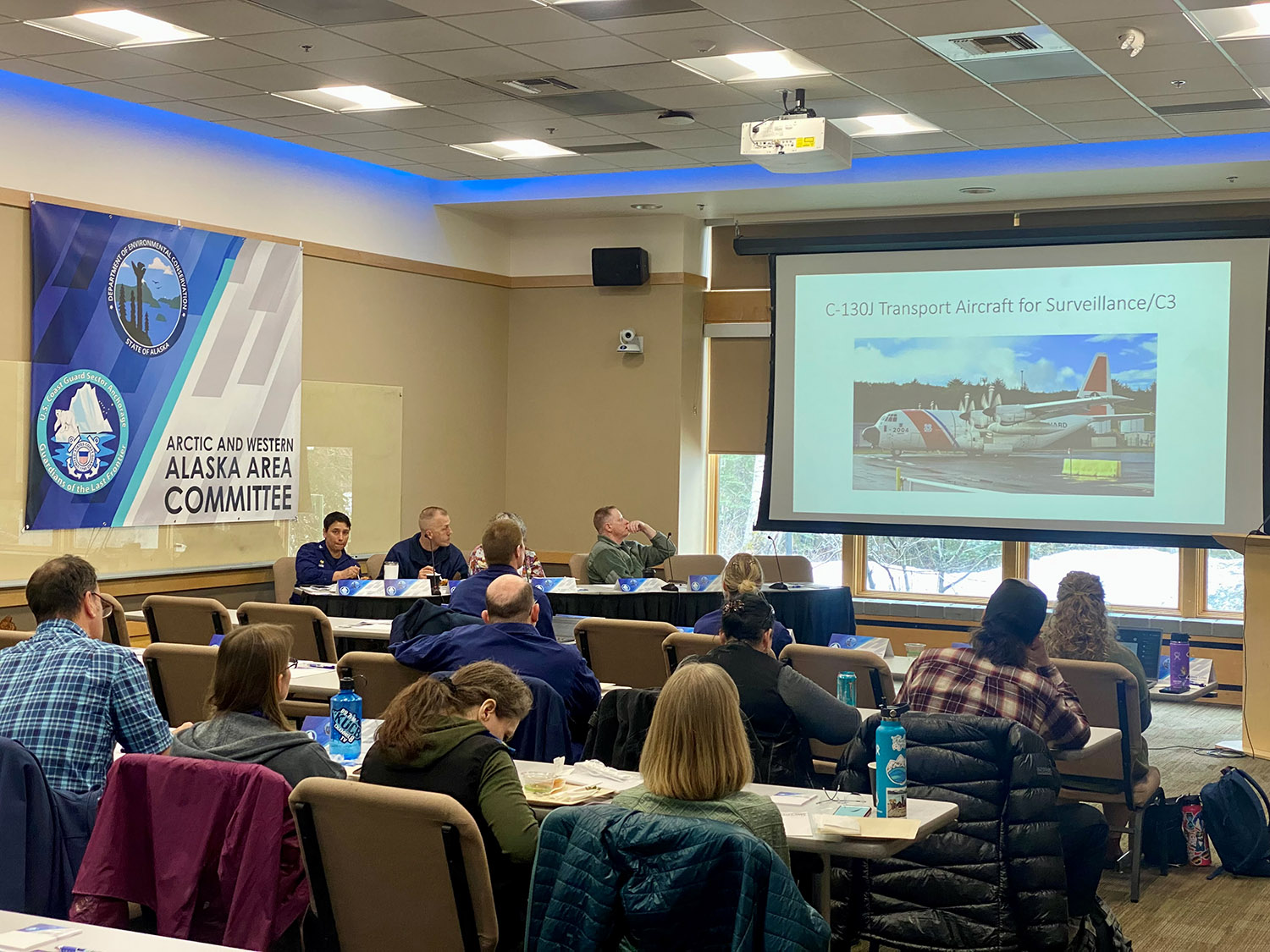
Arctic and Western Alaska Area Committee members receive a briefing on C-130J aviation operations as part of an upcoming oil spill exercise in Western Alaska during a spring 2023 meeting. This committee is where the public and interagency partners meet to discuss rural Alaska operations as they relate to oil and chemical spill planning, preparedness, and response. Coast Guard photo by CDR Jereme Altendorf
ISSUE: Fall 2025
AUTHOR: Jereme M. Altendorf
Associate Director for Arctic Programs and Strategy Implementation
Office of Research
University of Alaska Anchorage
Operating in the Arctic and Western Alaska presents unparalleled challenges for organizations, particularly those engaged in security, emergency response, and infrastructure development. The region’s extreme climate, logistical constraints, unique culture, and complex stakeholder landscape require a tailored approach to ensure mission success. The Coast Guard, Federal Emergency Management Agency, or any other government entity or private sector organization operating in this region must adapt their methodologies to overcome these challenges. Using a strategic planning framework approach, this article outlines five critical steps organizations should take to establish operational resilience and effectiveness in the Arctic and Western Alaska.
Strategic planning is essential for any organization operating in complex environments. The strategic planning process involves assessing the current environment, setting clear objectives, formulating action plans, implementing those plans, and evaluating outcomes for continuous improvement. By embedding these principles into Arctic operations, organizations can enhance mission success while fostering resilience in this challenging region. By implementing these five Arctic operations principles—organizational commitment, dedicated teams, community integration, flexible logistics, and data-driven decision-making—government agencies and other organizations can enhance their effectiveness in this critical region.
Establish Organizational Commitment to Operational Success
Successfully executing operations in rural Alaska necessitates a top-down commitment to acknowledging and addressing the unique operational challenges posed by the region. Organizations must develop a formal policy framework which:
- Recognizes the extraordinary logistical and financial burdens of Arctic operations
- Acknowledges that successful missions require travel beyond the road system, with budget allocations reflecting this reality
- Identifies organizational structures, policies, and paradigms which may impede operational efficiency and revises them accordingly
- If your organization is a federal or state agency, establishes internal requirements to maintain the “government-to-government” relationship with tribal governments. This includes recognizing tribal sovereignty and ensuring processes exist to determine when and what types of consultation is required before taking actions that could impact their communities. A simple guiding principle is this: “Nothing about them, without them.”
- Ensures Alaska Native communities and corporations are integral stakeholders in planning and execution
From a strategic planning perspective, organizations should conduct a situational analysis long before operations commence. This includes identifying strengths, weaknesses, opportunities, and threats, also referred to as a SWOT analysis, in the Arctic operational environment. Understanding these factors will enable leadership to craft well-informed strategies tailored to the region’s constraints and strengths.
A dedicated task force or work group should be established to oversee these efforts. This body must include personnel with operational experience in the region and external consultants familiar with rural Alaska’s challenges. Their responsibilities should include reviewing policy documents, evaluating logistical frameworks, and recommending necessary modifications to organizational procedures before field operations commence.
Further, organizations must build institutional knowledge to support sustainable Arctic operations. This includes internal training programs, scenario-based exercises, and the documentation of lessons learned from past missions. The presence of institutionalized Arctic knowledge reduces the learning curve for new personnel and ensures continuity despite inevitable staffing changes over time.
A full accounting of the SWOT analysis, recommendations for organizational changes, updates to standard operating procedures and other organizational doctrine should be clearly provided in a report for the record. It should also form the basis for the creation and initial work of the organizations’ Arctic and Western Alaska operations team.

Coast Guard Sector Western Alaska and U.S. Arctic operations crews load gear following two to three weeks of mission activities in the Bristol Bay area in 2021. Coast Guard photo by Petty Officer 2nd Class Holly Bernosky
Develop a Dedicated Arctic and Western Alaska Operations Team
Organizations must avoid the common pitfall of treating Arctic operations as a collateral duty assigned to personnel unfamiliar with the region. Instead, a full-time, dedicated Arctic operations team should be established, consisting of the following key roles.
- Tribal liaison: A professional focused on maintaining strong relationships with Alaska Native communities and ensuring that cultural sensitivities and tribal sovereignty considerations are embedded in operations.
- Deployment and logistics experts: Personnel specialized in mission scheduling, stakeholder engagement, budgeting, aviation, and maritime logistics.
- Travel coordinator and contracting officer: Individuals responsible for managing complex travel arrangements and ensuring timely procurement of necessary services and materials.
This team’s primary function should be to ensure operational planning reflects the region’s realities, including budget forecasting, logistical planning, and staffing requirements. A clear doctrine should outline conditions which warrant the expansion or contraction of the team based on mission scope and regional dynamics. While the structure of full-time leadership is at the organization’s discretion, the highest likelihood of success comes from appointing personnel with extensive Alaska-specific operational or logistical experience who are based within the state.
It may be tempting to establish a team where field personnel operate in Alaska while organizational leadership is located elsewhere. However, a remotely managed structure, where key decision-makers are outside the region while deployment-eligible personnel are in-state, is not advisable until an organization has accumulated years of documented operational success. Even then, considering the significant investment required to operate effectively in the Arctic and Western Alaska, organizations should prioritize basing their entire Alaska operations team within the state to maximize efficiency, adaptability, and long-term mission success.
In addition, a robust team should conduct ongoing assessments of evolving environmental and geopolitical factors. For instance, permafrost thaw is rapidly reshaping Arctic landscapes, sea ice patterns are continually shifting, and river routes are getting less predictable, all of which affect seasonal accessibility. Similarly, increasing global interest in Arctic resource extraction and shipping necessitates a proactive approach to operational planning. A dedicated Arctic operations team must continuously monitor these shifts and adjust operational strategies accordingly.
From a strategic framework perspective, organizations should set SMART goals—specific, measurable, achievable, relevant, and time-bound—for their Arctic operations teams. Establishing performance metrics for logistics, engagement, and mission execution allows leadership to measure success and make informed adjustments over time.
Prioritize Year-Round Engagement and Community Integration
Mission success in Arctic and Western Alaska depends on sustained, community-focused engagement. Organizations should recognize that their operational schedules must align with local priorities rather than impose external timelines. There are several best practices for effective community engagement.
- Scheduling events around community availability: Conducting in-person meetings, training sessions, and exercises on schedules that work for local elders, leaders, and other important stakeholders.
- Allowing for extended operational presence: A two-day engagement may require a full week on the ground to accommodate travel limitations and ensure meaningful interactions.
- Leaving behind tangible resources: Providing training materials, signage, or locally relevant resources that enhance community resilience.
- Using multiple communication platforms: Engaging with local radio stations, newspapers, and social media to ensure outreach extends beyond hub communities.
- Demonstrating operational preparedness: Showing respect for local conditions by arriving with the necessary equipment and knowledge to function independently in remote settings.
- Providing language translation services: Ensuring communication materials and meetings include regionally dependent Alaska Native language translation services to enhance accessibility and cultural inclusion.
- Recognizing subsistence lifestyles: Acknowledging that many communities rely on traditional land and marine use for subsistence and incorporating this understanding into operational planning to minimize disruptions and foster trust. This must include an analysis of seasonality for each region and community, as subsistence seasons will vary from region to region and community to community.
- Don’t Overschedule: Organizations should also avoid the common mistake of clustering events with other scheduled activities, which can lead to stakeholder fatigue and diminished engagement.
Arctic communitis have a deep understanding of their environment and can offer invaluable guidance on weather patterns, travel risks, and emergency preparedness, so integrating local knowledge into planning and operations enhances mission success. To avoid operational delays, seek local expert evaluations for your organization’s policies, plans, and procedures prior to official deployment to rural Alaskan communities.
From a strategic planning standpoint, organizations should conduct stakeholder mapping to identify key local influencers, decision-makers, and partners. Engaging these stakeholders early in the planning process ensures that operational efforts align with community needs, thereby increasing local buy-in and long-term cooperation.
Organizations can leverage key performance indicators (KPIs) to track and enhance their engagement strategies. KPIs, such as the frequency and quality of community interactions, feedback from tribal leaders, and the success rate of logistical operations, can be used to generate annual operational reviews. These external reports help organizations evaluate the impact of their Arctic missions and refine engagement strategies based on measurable outcomes. Additionally, transparent reporting fosters trust and accountability, demonstrating a long-term commitment to supporting Arctic communities.
Implement a Flexible, Realistic Budgeting and Logistics Framework
Operating in rural Alaska demands robust logistical flexibility and financial planning but requires organizations to anticipate elements of their budget when planning.
- Travel costs will be significantly higher: Budgets must reflect the true cost of mission success, often requiring a three- or four-fold increase in standards travel allocations.
- Transportation infrastructure is limited: Organizations must account for regional airline availability, the need for private aviation charters, and worst-case transportation scenarios.
- Operational seasons dictate mission feasibility: Teams should differentiate between summer and winter operational plans, aligning logistics accordingly.
- Hub communities serve as strategic launch points: Generally speaking, aviation logistics are how your organization will determine primary hub communities from which to operate. Locations such as Anchorage, Kotzebue, Nome, Utqiaġvik, Fairbanks, Bethel, and Unalaska are natural choices due to their established aviation support infrastructure. Other hub communities may be identified based on specific operational drivers or in-community requirements.
Field teams must be empowered to adjust their operational models based on real-world conditions to ensure mission success is not hindered by rigid bureaucratic or other organizational constraints. Allowances must also be made to ensure polices, standard operating procedures, and other guidance recognizes various cultural and language differences across the region. As previously stated, any strategic implementation of operations that procedurally requires participation from the community at large, or of individuals within the community, must be tested from beginning to end.
Consistent with this operational excellence mindset is the need to deploy a mechanism for feedback to your organization’s knowledgeable Western Alaska and Arctic personnel. Previous experiences have shown that organizations which manage customer service calls from the region without involving knowledgeable personnel end up improperly redirecting callers due to miscommunication, leading to issues not being addressed in a timely fashion, if at all.
Additionally, logistics planning should include redundancy measures. Given the unpredictable nature of Arctic travel—where flights may be frequently canceled due to weather or mechanical issues—organizations must incorporate backup plans into their deployment strategies. Having alternative transportation arrangements, emergency supply caches, and robust contingency funding ensures critical operations can proceed even in the face of logistical setbacks.
Strategically, organizations should integrate scenario planning into their budgeting and logistics frameworks. By considering multiple operational contingencies, such as extreme weather disruptions or supply chain interruptions, organizations can proactively adjust plans and resources to ensure sustained Arctic operations.
Institutionalize Data-Driven Decision-Making and Continuous Improvement
To enhance long-term operational effectiveness, organizations must embed mechanisms for data collection and analysis within their Arctic operations to allow for a number of elements.
- Quantifiable evaluation of mission effectiveness: Using data to assess the return on investment and identify areas for improvement.
- Justification for budget requests and operational adjustments: Leveraging metrics to advocate for necessary resources.
- Dynamic adaptation to evolving conditions: Ensuring operational strategies remain relevant and responsive to changes in the Arctic environment.
- Knowledge-sharing and legacy-building: Publishing insights, lessons learned, and operational success stories to benefit other organizations and stakeholders operating in the region.
By integrating real-time analytics into their planning cycles, organizations can continuously refine their Arctic strategies, ensuring sustainable and effective operations.
Furthermore, data collection should be supplemented by qualitative assessments from personnel operating in the field. Firsthand observations of environmental changes, infrastructure challenges, and local observations, thoughts, and opinions can provide critical context that raw data alone cannot capture. Encouraging an open feedback loop between field operators and strategic planners ensures decision-making remains well-informed and responsive to emerging challenges.
The strategic planning framework calls for the implementation of KPIs to track progress and effectiveness. Establishing measurable benchmarks for Arctic missions ensures that data-driven insights inform future operational improvements and strategic pivots.
Developing and Using KPIs Effectively
KPIs are essential tools for measuring an organization’s progress toward its strategic goals. The process of creating and using KPIs requires several steps.
1. Identify organizational objectives: Before selecting KPIs, leadership must define clear, strategic goals related to Arctic operations, such as increasing mission efficiency, improving community engagement, or reducing logistical costs.
2. Determine measurable metrics: Effective KPIs should be specific, quantifiable, and actionable. Examples of KPIs for Arctic and Western Alaska operations include:
- Number of successful community engagements per quarter
- Average response time to customer complaint/feedback calls
- Percentage of mission-critical supplies delivered on time
- Reduction in logistical costs over a defined period
3. Set performance benchmarks: Organizations must establish baseline data and performance targets to evaluate success.
4. Implement data collection methods: Organizations should integrate technology such as geographic information system tracking, automated reporting systems, and feedback surveys to collect real-time data relevant to their KPIs.
5. Monitor and evaluate KPI progress: Regular data reviews help leadership identify trends, address performance gaps, and make necessary adjustments. Monthly or quarterly KPI review meetings ensure ongoing accountability.
6. Adjust strategies based on KPI insights: If an organization is failing to meet a KPI target, leadership must determine whether operational changes, additional resources, or alternative strategies are necessary.
KPIs serve as a feedback mechanism, allowing organizations to refine their operational strategies based on real-world performance data. By integrating KPI analysis into decision-making, organizations can ensure they continuously improve efficiency, effectiveness, and adaptability in Arctic and Western Alaska missions.
Conclusion
The Arctic and Western Alaska regions present formidable operational challenges, but with strategic foresight, dedicated personnel, and a commitment to community engagement, organizations can achieve mission success. By institutionalizing these five principles—organizational commitment, dedicated teams, community integration, flexible logistics, and data-driven decision-making—government agencies and other organizations can enhance their effectiveness in this critical region. As more powerful storms increase erosion and flooding, permafrost continues to thaw, and geopolitical dynamics continue to shape the Arctic landscape, a well-prepared operational framework will be essential for ensuring security, sustainability, and resilience in the years to come.
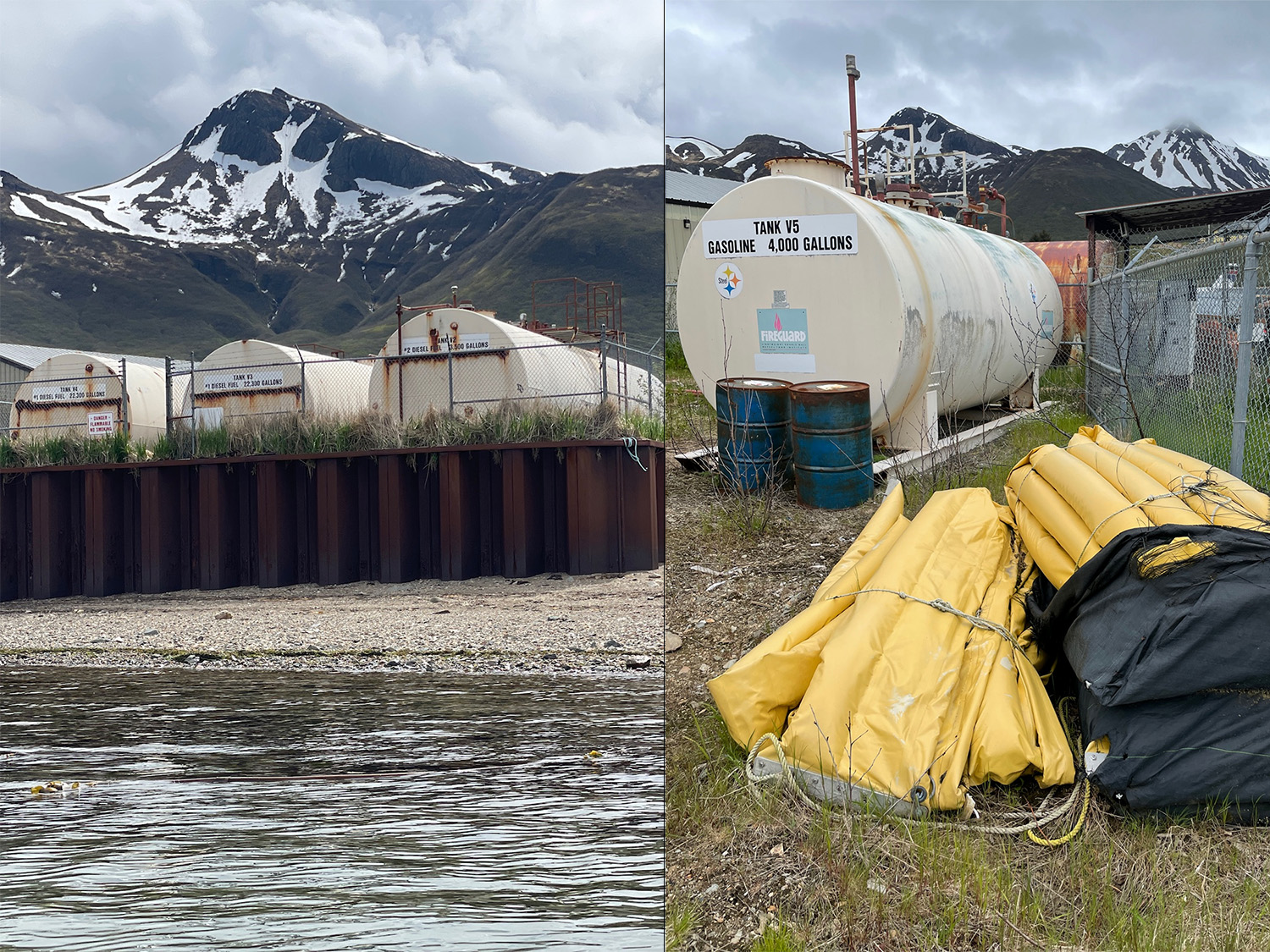
Inspections of bulk fuel facilities like this one in Chignik Lagoon, Alaska, are crucial to protecting the environment and the populations living near them. However, many of the inspections performed by Coast Guard Sector Western Alaska and U.S. Arctic require strategic planning because of the region’s vastness. Coast Guard photo by Petty Officer 2nd Class Holly Bernosky
About the author:
Jereme M. Altendorf retired from the Coast Guard after 22 years on active duty and is currently the associate director for the University of Alaska Anchorage’s (UAA) Office of Research Arctic Programs and Strategy Implementation. In this role, he oversees critical initiatives aimed at advancing research and strategic engagement in the Arctic, fostering collaborative solutions to regional security and environmental challenges, and supporting sustainable development in Alaska and beyond. He supports the Department of Homeland Security’s newest Center of Excellence, ADAC-Arctic, and UAA’s Applied Environmental Research Center.